
A guitar sitting in the corner can feel like an invitation and a challenge at the same time. You want to play songs, but the strings buzz, the chords feel awkward, and every online lesson seems to start in a different place.
That is why learning guitar at home should not begin with complicated theory or fast songs. It should begin with a simple routine that teaches your hands, ears, and timing to work together one small step at a time.
Can You Really Teach Yourself Guitar at Home?
Yes, you can teach yourself guitar at home, especially if you start with structure. Most beginners do not quit because they lack talent. They usually quit because they try to learn too much at once or jump between random tutorials without mastering the basics.
A smarter approach is to break guitar learning into small physical skills. First, learn the parts of the guitar. Then learn how to tune it. After that, work on holding a pick, pressing clean notes, switching easy chords, and strumming in time. When you follow that order, you can often play a simple real song within your first week.
What Should Beginners Know Before Playing Songs?
Before you play music, get comfortable with the instrument itself. The headstock holds the tuning pegs. The neck is where your fretting hand works. The metal dividers across the neck are frets. The body creates the sound on an acoustic guitar and supports the pickups on an electric guitar.
The standard guitar strings, from thickest to thinnest, are E, A, D, G, B, and E. Memorizing this early helps you follow beginner guitar lessons, tuning apps, chord diagrams, and guitar tabs with confidence.
You should also tune your guitar before every practice session. A beginner can press the right chord shape and still sound bad if the guitar is out of tune. Use a free app like GuitarTuna or a simple clip-on tuner so every session starts with the correct sound.
Should You Start With Acoustic or Electric Guitar?

The best beginner guitar is the one that matches the music you want to play. If you love country, folk, worship music, singer-songwriter tracks, or casual living room practice, an acoustic guitar is a strong choice. It is simple, portable, and does not require an amplifier.
If you love rock, blues, metal, pop leads, or modern electric tones, an electric guitar may feel more exciting. Electric strings often feel lighter, which can make early finger pressure easier. Both acoustic and electric guitar options work for beginners. I would rather see a new player buy a guitar they want to pick up every day than choose one based only on tradition.
What Is the Best Practice Setup at Home?
Your setup does not need to look like a studio. A quiet corner, comfortable chair, guitar stand, tuner, pick, phone, and notebook are enough. Keep the guitar where you can see it. If it stays hidden in a case, practice becomes easier to skip.
Choose a thin pick around 0.5 mm when starting out. Hold it gently between your thumb and index finger, with only a small part showing. Think of brushing the strings like a paintbrush instead of attacking them. A relaxed pick grip helps your strumming sound smoother and keeps your hand from tensing up.
What Chords Should You Learn First?
Start with open chords, often called cowboy chords. These are the basic guitar chords used in thousands of popular songs. The easiest starting pair is E minor and A sus2 or A major because they require small finger movements and help you build confidence quickly.
After that, focus on G major, D major, E minor, and C major. These four chords unlock many beginner pop, rock, country, and worship songs. Do not rush through them. A clean chord is better than a fast, messy one.
Use the claw technique when fretting notes. Curl your fingers so your fingertips press the strings just behind the metal fret wire, not directly on top of it. This helps reduce buzzing and keeps nearby strings from getting muted by accident.
What Is the Best Way to Learn Guitar at Home?
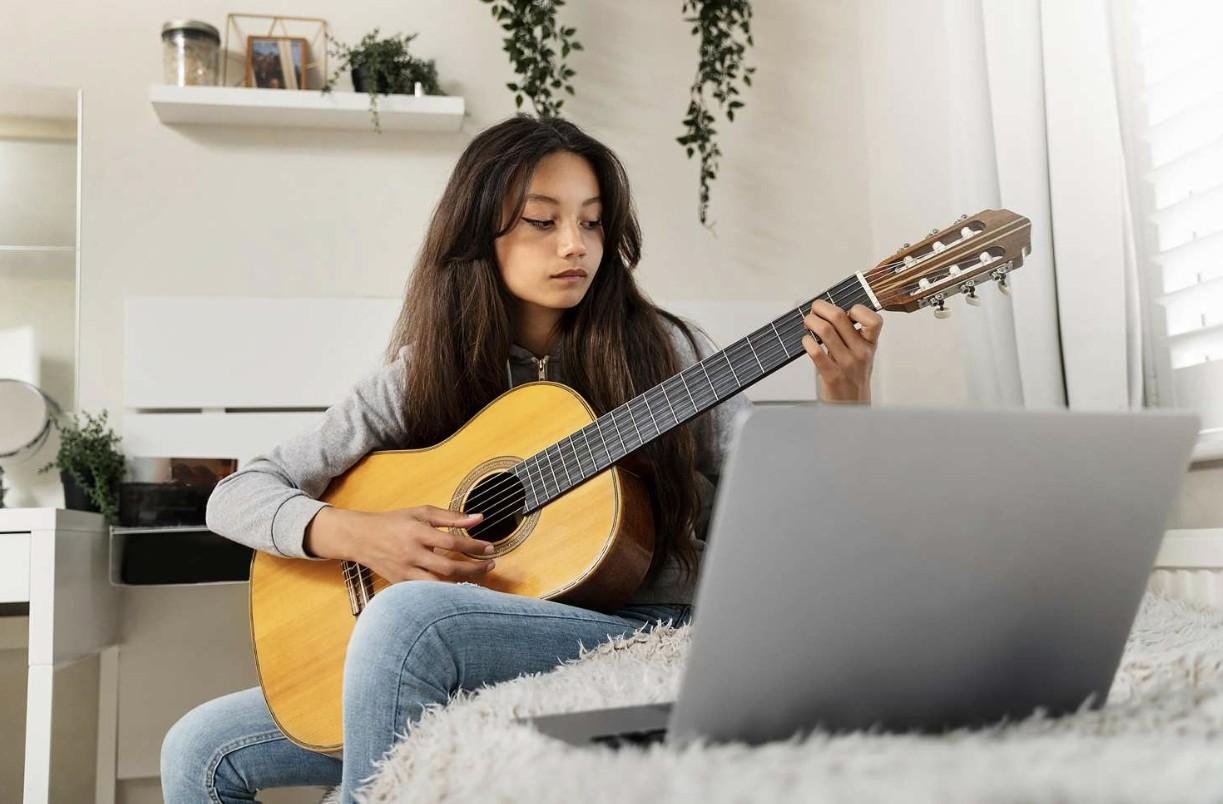
The best way to learn guitar at home is to practice smart, not long. Muscle memory develops through repetition and rest, so short daily sessions usually beat one long weekend practice.
Start with five minutes a day if that is all you can manage. Make those five minutes focused on the uncomfortable part, such as switching between two chords, cleaning up a buzzing note, or strumming evenly with a metronome. Once the habit feels easy, increase your session to 15 or 20 minutes.
One of my favorite beginner drills is the one-minute chord-change exercise. Pick two chords, set a timer for 60 seconds, and switch between them as many times as you can while keeping the shapes clean. Write down your number and try to improve it over the week.
How Can Beginners Build Rhythm Faster?
Rhythm is what makes simple chords sound like music. Many beginners only focus on finger placement, but timing matters just as much. To train rhythm, mute the strings with your fretting hand and practice downstrums with a metronome app.
This removes the pressure of chord changes and lets your strumming hand learn steady movement. Once your timing feels natural, bring the chords back in. Start slow. A simple downstrum pattern played in time sounds better than a complicated pattern played unevenly.
Which Free Online Guitar Resources Are Worth Using?
Free resources can work extremely well when you use them with a plan. JustinGuitar is one of the best places to start because it offers structured beginner lessons that move in a clear order. This helps you avoid the common problem of bouncing between unrelated videos.
YouTube is great for song motivation. Marty Music is useful when you want beginner-friendly song tutorials, while Paul Davids is helpful when you want inspiration, technique explanations, and musical ideas. Use these channels as support, but do not let random videos replace your main learning path.
When you are ready to read guitar tabs, Songsterr can help because it shows interactive tabs with playback. Tabs are like visual sheet music for guitar, and they make it easier to learn riffs, melodies, and song parts once your basic timing improves.
What Should Your First 7 Days Look Like?
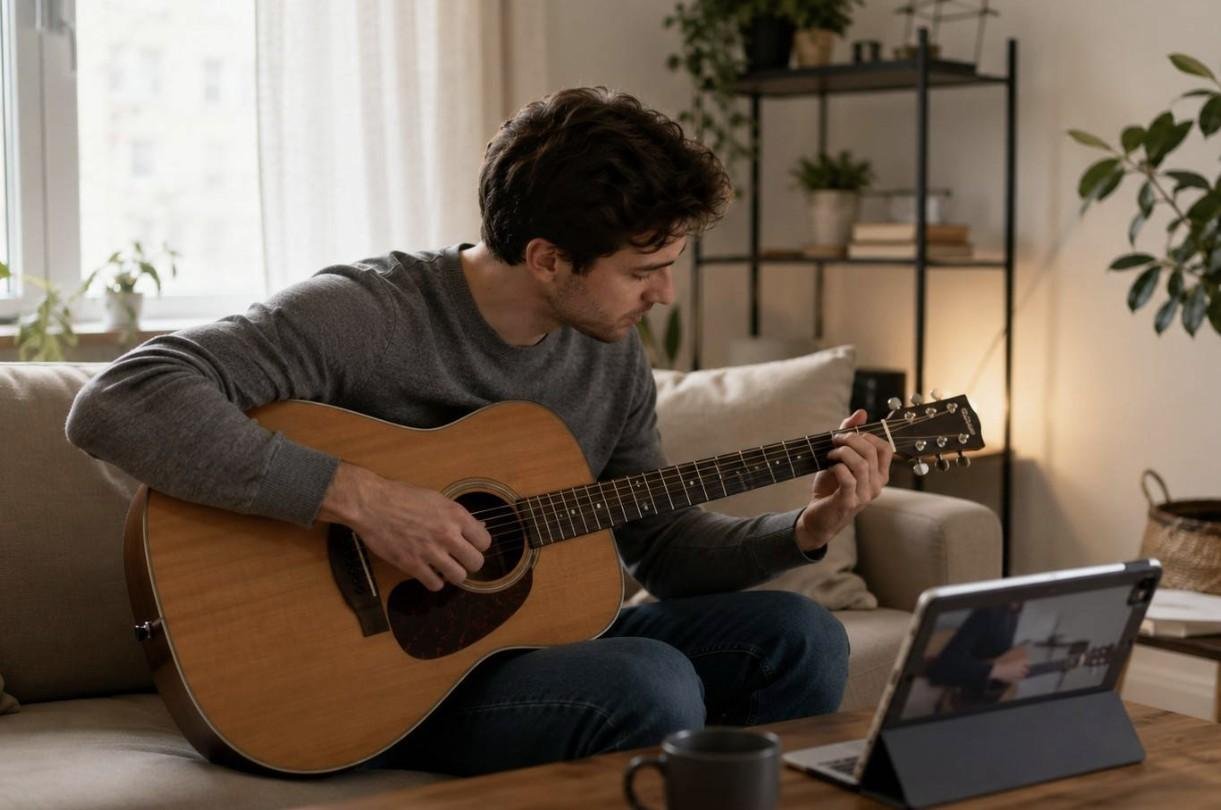
During the first day, learn the guitar parts, string names, and how to tune your instrument. On day two, practice holding the pick and strumming gently across muted strings. On day three, learn E minor and A sus2 or A major. On day four, practice switching between those chords with a timer.
On day five, add G major or D major. On day six, practice a simple downstrum pattern with a metronome. On day seven, use two or three chords to play a very easy song or a simplified version of a song you already like.
This plan keeps the first week realistic. The goal is not perfection. The goal is to hear yourself making music as early as possible.
How Long Does It Take to Get Good at Guitar?
Most beginners can learn a few open chords within the first week. After one month of steady practice, you may be able to play simple songs with slow chord changes. After three to six months, your rhythm, chord transitions, and confidence can improve dramatically if you stay consistent.
Progress depends less on talent and more on repetition. A beginner who practices 15 focused minutes daily usually improves faster than someone who practices for two hours once a week. The same idea applies to learning piano at home, where short, regular practice sessions often create better progress than occasional long sessions.
Frequently Asked Questions (FAQs)
1. Can I learn guitar at home without a teacher?
Yes, you can learn without a teacher if you follow structured beginner lessons, practice daily, and use reliable tools like tuners, metronomes, chord charts, and tabs.
2. What is the easiest guitar chord for beginners?
E minor is one of the easiest beginner guitar chords because it uses only two fingers and sounds full.
3. How many minutes should I practice guitar every day?
I recommend 15 to 20 minutes daily for beginners, but even five focused minutes can build a strong habit.
4. What is the fastest way to play my first song?
Learn two or three easy open chords, practice clean chord changes, use a simple downstrum pattern, and choose a slow beginner-friendly song.
Final Thoughts
Learning guitar at home becomes much easier when you stop trying to learn everything at once. I would start with the setup, learn the string names, tune every time, build clean open chords, and practice short daily drills that train your hands and rhythm together.
The real secret is consistency. Use JustinGuitar for structure, GuitarTuna for tuning, Marty Music and Paul Davids for extra inspiration, and Songsterr when you are ready for tabs. If you stay patient and keep your practice simple, learning guitar at home becomes less confusing and much more rewarding.